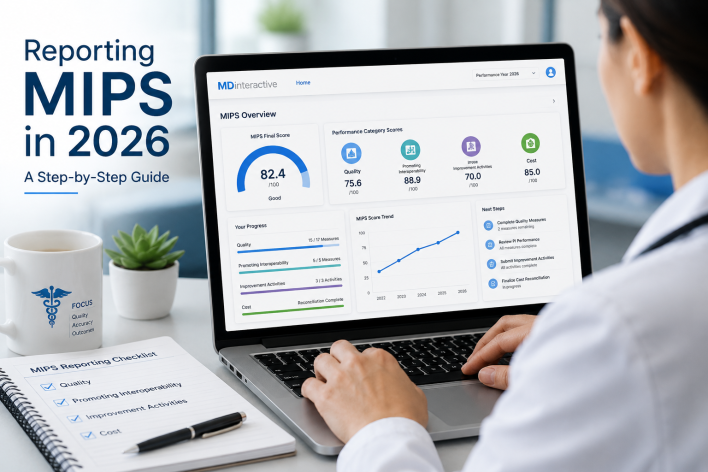
2026 MIPS reporting requires practices to stay proactive, organized, and prepared throughout the performance year. With updates to quality measures, MIPS Value Pathways (MVPs), and measure benchmarks that can significantly affect scoring, early planning can help reduce reporting burdens, improve scores, and help avoid negative payment adjustments. In this article, we’ve outlined a step-by-step checklist to help your practice stay organized, reduce reporting burdens, and achieve success with 2026 MIPS.
Step 1: Confirm Your 2026 MIPS Eligibility
Before developing your reporting plan, it’s important to determine if you are required or eligible to participate in MIPS for the 2026 performance year. The CMS QPP Participation Status Tool is your go-to resource for verifying:
- Individual and group MIPS eligibility
- Whether you are a Qualifying APM Participant (QP) or a Partial QP
- Eligibility to opt-in or voluntarily report
- Special statuses such as Small Practice, Non-Patient Facing, Rural, or HPSA designation
Eligibility can change during the year, especially if you join an APM Entity, begin billing under a new Tax Identification Number (TIN), or participate in an Advanced APM. Keep in mind that QP determinations are updated throughout the year, so practices participating in Advanced APMs should periodically recheck their status for updates.
Be sure to check the CMS QPP Participation Status Tool again at the end of 2026 for any updates.
MDinteractive customers can also check their dashboard to view current MIPS eligibility status.
Step 2: Choose How You’ll Report: Individual, Group, or APM Entity
One of your first decisions is how you plan to report your MIPS data. You can:
- Report as an individual, based on your own individual NPI/TIN performance
- Report as a group, where performance is aggregated across all clinicians billing under the same TIN
- Report as part of a subgroup
- Participate as part of an APM Entity if you are in a qualifying alternative payment model
Group reporting can be advantageous if performance varies across clinicians, but you’ll want to ensure the aggregated score aligns with your goals. When reporting as a group, all clinicians billing under the TIN receive the same final MIPS score and payment adjustment, regardless of their individual performance. This applies to clinicians who may not have been individually MIPS eligible on their own. Reporting as an individual allows more control, especially if your performance differs from that of your peers.
Practices considering MVP reporting in 2026 should also be aware that multispecialty groups generally may no longer report MVPs at the group level unless they qualify as a small practice. These groups may instead need to report as subgroups.
Step 3: Choose What You’ll Report: Traditional MIPS or an MVP
After deciding how you’ll report, you must choose what pathway to report under:
- Traditional MIPS allows clinicians to select their own Quality measures and Improvement Activities while reporting the required Promoting Interoperability measures, unless the category is automatically reweighted.
- MIPS Value Pathways (MVPs) offer pre-defined, specialty- or condition-specific sets of measures that better align with clinical workflows.
CMS continues expanding MVP options in 2026, including the addition of new MVPs for specialties such as:
Traditional MIPS still offers flexibility in choosing measures, while MVPs streamline measure selection and may better align with specialty-focused reporting.
Step 4: Understand and Prepare for Category Requirements
MIPS scores are based on four performance categories. Here’s a snapshot of what’s required in 2026:
Quality
The Quality category continues to play a major role in final MIPS scores. In 2026, clinicians must generally report:
- 6 quality measures (or 4 measures if reporting an MVP from the applicable MVP measure set)
- Including at least one outcome measure or, if an outcome measure is unavailable, one high-priority measure
- For the full calendar year (January 1, 2026 to December 31, 2026)
- Across all eligible encounters and all payers
Because CMS updates the Quality measure inventory each year, practices should review available 2026 measures before finalizing their reporting plan. Make sure the measures you want to report are still available and carefully review updated measure specifications and reporting requirements.
New quality measures added for 2026 include:
- #512 Prevalent Standardized Kidney Transplant Waitlist Ratio (PSWR) — MIPS CQM
- #513 Patient Reported Falls and Plan of Care — MIPS CQM
- #514 Diagnostic Delay of Venous Thromboembolism in Primary Care — eCQM
- #515 Screening for Abnormal Glucose Metabolism in Patients at Risk of Developing Diabetes — eCQM
- #516 Hepatitis C Virus (HCV): Sustained Virological Response (SVR) — MIPS CQM
Practices should review these new measures to determine whether any align with their specialty, patient population, or reporting strategy.
Several measures were also removed from the MIPS program for 2026, including:
- #185 Colonoscopy Interval for Patients with a History of Adenomatous Polyps – Avoidance of Inappropriate Use
- #264 Sentinel Lymph Node Biopsy for Invasive Breast Cancer
- #290 Assessment of Mood Disorders and Psychosis for Patients with Parkinson's Disease
- #322 Cardiac Stress Imaging Not Meeting Appropriate Use Criteria: Preoperative Evaluation in Low-Risk Surgery Patients
- #419 Overuse of Imaging for the Evaluation of Primary Headache
- #424 Perioperative Temperature Management
- #443 Non-Recommended Cervical Cancer Screening in Adolescent Females
- #487 Screening for Social Drivers of Health
- #498 Connection to Community Service Provider
- #508 Adult COVID-19 Vaccination Status
Practices that previously reported these measures should identify alternative reporting options for 2026.
Because benchmarks can change from year to year, practices should also confirm that selected measures have reliable benchmarks and understand how benchmark changes may impact scoring. 2026 Quality measure benchmarks can be reviewed here.
Promoting Interoperability (PI)
To report the Promoting Interoperability (PI) category, you must use Certified Electronic Health Record Technology (CEHRT) for a continuous 180-day performance period during the calendar year.
Automatic reweighting continues to apply to certain clinician types and special statuses, including:
- Hospital-based clinicians
- ASC-based clinicians
- Non-patient facing clinicians
- Small practices
Practices should also review current Public Health and Clinical Data Exchange requirements and confirm whether any exclusions apply.
Before beginning PI reporting for 2026, practices should review updated PI measure requirements and confirm their workflows and documentation processes are aligned with current CMS requirements. For example, the Security Risk Analysis measure now requires clinicians to attest that they performed risk management activities consistent with the HIPAA Security Rule. In addition, clinicians completing the High Priority Practices measure must use the updated 2025 SAFER Guides during their self-assessment process.
Practices should also review available bonus opportunities within the Public Health and Clinical Data Exchange objective. CMS added a new optional Public Health Reporting Using TEFCA bonus measure for 2026. Clinicians may earn up to 5 bonus points by reporting one or more optional bonus measures under this objective.
Improvement Activities (IA)
Clinicians must attest to completing Improvement Activities for a minimum of 90 continuous days during the performance year.
The number of required activities depends on your reporting pathway and special status:
If reporting through Traditional MIPS:
- Clinicians, groups, and virtual groups with Small Practice, Rural, Non-Patient Facing, or HPSA special status must attest to 1 activity
- All other clinicians, groups, and virtual groups must attest to 2 activities
If reporting through an MVP:
- Clinicians, groups, and subgroups generally must attest to 1 activity
Before selecting activities for 2026 reporting, practices should review the updated Improvement Activities inventory to confirm selected activities are still available and ensure documentation workflows support attestation requirements.
CMS adopted three new Improvement Activities for the 2026 performance year:
- IA_PM_27: Improving Detection of Cognitive Impairment in Primary Care
- IA_PM_28: Integrating Oral Health Care in Primary Care
- IA_PSPA_34: Patient Safety in Use of Artificial Intelligence (AI)
Practices should review these new activities to determine whether any align with existing workflows or initiatives already being performed within the organization.
CMS also removed several Improvement Activities for the 2026 performance year, including:
- IA_AHE_5 – MIPS Eligible Clinician Leadership in Clinical Trials or CBPR
- IA_AHE_8 – Create and Implement an Anti-Racism Plan
- IA_AHE_9 – Implement Food Insecurity and Nutrition Risk Identification and Treatment Protocols
- IA_AHE_11 – Create and Implement a Plan to Improve Care for Lesbian, Gay, Bisexual, Transgender, and Queer Patients
- IA_AHE_12 – Practice Improvements that Engage Community Resources to Address Drivers of Health
- IA_PM_26 – Vaccine Achievement for Practice Staff: COVID-19, Influenza, and Hepatitis B
- IA_PM_6 – Use of Toolsets or Other Resources to Close Health and Health Care Inequities Across Communities
- IA_ERP_3 – COVID-19 Clinical Data Reporting with or without Clinical Trial
- IA_PM_12 – Population Empanelment
- IA_CC_1 – Implementation of Use of Specialist Reports Back to Referring Clinician or Group to Close Referral Loop
- IA_CC_2 – Implementation of Improvements that Contribute to More Timely Communication of Test Results
- IA_BMH_8 – Electronic Health Record Enhancements for BH Data Capture
Practices that previously relied on these activities should review alternative reporting options for 2026.
Cost
The Cost category is calculated automatically by CMS using administrative claims data. No submission is required, but performance in this category still impacts your final MIPS score.
Although clinicians do not submit Cost data directly, practices should continue monitoring resource utilization, hospitalizations, referrals, and care coordination efforts throughout the year.
Step 5: Choose Your Measures Strategically
Measure selection continues to play a major role in overall MIPS success. Carefully review the 2026 measure specifications to confirm that:
- Your selected measures are still available for reporting
- You understand how each measure must be reported and scored
- Your selected measures are not topped out
- Your measures have established benchmarks
- Your workflows support complete and accurate data collection
Benchmark changes can significantly impact performance scoring, even if your clinical performance remains the same from prior years.
Measure selection continues to play a major role in overall MIPS success, so practices should review scoring opportunities early rather than waiting until submission season.
Step 6: Begin Tracking and Submitting Early
Don’t wait until the submission window opens in 2027 to start thinking about reporting. Collecting and monitoring your performance data throughout the year helps:
- Identify areas for improvement
- Avoid surprises when it’s time to submit
- Ensure data completeness and accuracy
- Monitor benchmark performance trends
- Improve overall scoring opportunities
Working with a CMS Qualified Registry like MDinteractive can simplify data collection and help ensure your submission to CMS is accurate and submitted on time.
Final Thoughts
MIPS reporting in 2026 doesn’t have to be overwhelming. With a solid plan and ongoing performance monitoring, your practice can stay organized and position itself for reporting success.
Our team at MDinteractive is here to support you every step of the way—from eligibility verification to final submission. If you're ready to get started or have questions about your 2026 reporting strategy, contact one of our MIPS specialists today.