For many ACOs, the shift to eCQM reporting creates a real operational challenge because participating practices often use different EHR systems, some of which may not be certified for all required APM Performance Pathway (APP) eCQM measures. With more than 25 years of CMS quality reporting experience, MDinteractive helps ACOs navigate this shift by transforming clinical and administrative data from disparate EHR systems — accessed via direct export or FHIR APIs — into compliant APP eCQM submissions, even when participating EHRs may not support all measures natively.
Why Many ACOs Are Moving Toward eCQM Reporting
Beginning with the 2027 performance year, MIPS CQMs are expected to be removed as a reporting option under the APM Performance Pathway — making the transition more urgent. Beyond the deadline, eCQM reporting may also offer a performance advantage: unlike Medicare CQMs, which require ACOs to meet the 40th percentile across the entire MIPS Quality category, eCQM reporting follows the "10/40 Rule," requiring only the 10th percentile on one outcome measure and the 40th percentile on one additional measure.
MDinteractive’s eCQM Conversion and Transformation Capabilities
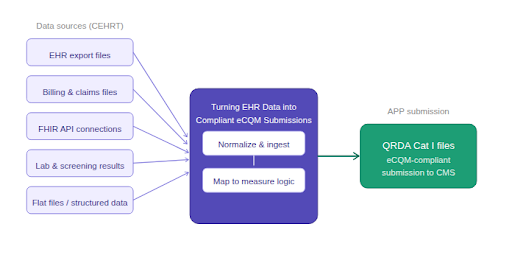
MDinteractive bridges the gap between disparate certified EHR systems and compliant CMS eCQM submissions. Our platform and subject matter expertise transform clinical and administrative data from Certified EHR Technology (CEHRT) — whether retrieved through FHIR APIs or delivered through structured data exports — into the QRDA files required for eCQM submission. MDinteractive can also function alongside existing EHR systems as a certified Health IT module supporting quality reporting, interoperability, and compliant APP eCQM workflows. This means participating practices can use different certified EHR systems with varying data formats and interoperability capabilities, and we handle the complexity of normalizing and mapping that data into a single compliant reporting workflow.
Data Elements Required for eCQM Conversion
To generate compliant QRDA files for eCQM reporting, organizations generally need to provide key clinical and administrative data elements exported from CEHRT or retrieved via FHIR API including:
Patient Demographics
- Patient name
- Date of birth
- Gender
Provider Information
- Provider NPI
- Tax Identification Number (TIN)
Visit and Encounter Data
- Dates of service
- CPT and HCPCS procedure codes
Diagnosis Information
- ICD-10 diagnosis codes
Clinical Measure Reporting Data
Clinical information needed to support measure calculations and reporting, such as:
- Laboratory results and test dates
- Blood pressure readings and vital signs
- Medication data
- Procedures and screenings
- Mammograms
- Colonoscopies
- PHQ-9 and PHQ screening results
When this data is available, MDinteractive can transform it into QRDA Category I files suitable for eCQM submission. For example, if a certified EHR exports billing encounter data along with laboratory result data such as HbA1c values, MDinteractive may be able to construct compliant QRDA files for APP eCQM measures such as APP #1: Diabetes: Glycemic Status Assessment Greater Than 9%.
Supporting ACOs with Practices Using Different EHR Systems
Many ACOs include participating practices using a variety of EHR systems with differing levels of APP eCQM support. Common challenges include:
- Multiple EHR systems across participating practices
- Inconsistent data export formats
- Limited or incomplete QRDA generation capabilities
- EHRs certified for some, but not all, APP measures
- Lack of internal expertise on CMS eCQM specifications
MDinteractive addresses these challenges by working with data exported from certified EHR systems or accessed through FHIR APIs, transforming it into compliant QRDA submission files. This flexible ingestion approach, supporting both traditional data exports and modern FHIR-based retrieval, means organizations are not dependent on any single EHR's native eCQM capabilities. By combining deep CMS quality reporting expertise with flexible data transformation, MDinteractive simplifies the transition for organizations managing diverse EHR environments.
Preparing for the Future of Digital Quality Reporting
CMS continues expanding electronic and interoperable quality reporting requirements across value-based care programs. As FHIR-based interoperability becomes increasingly central to CMS data exchange standards, organizations that begin preparing now will be better positioned for evolving requirements. MDinteractive helps ACOs navigate this landscape by combining Medicare program expertise, extensive knowledge of QRDA and eCQM specifications, and flexible data transformation capabilities that support disparate healthcare data sources — including FHIR-enabled environments.