What is Promoting Interoperability?
This performance category promotes patient engagement and electronic exchange of information using certified electronic health record technology (CEHRT). This performance category is worth 25% of your MIPS Final Score for 2026
MIPS eligible clinicians must use ONC Certified Health IT to collect and report their Promoting Interoperability data.
If you select the last 180-days in 2026 as your performance period, ONC Certified Health IT must be in place by July 5, 2026. Your EHR must be certified by Dec 31, 2026.
Are you unsure if your EHR complies with the ONC Certification Criteria for Health IT?
Search for your EHR on the Certified Health IT Product List (CHPL) website: https://chpl.healthit.gov/#/search.
Do you think you might qualify for an exception for PI?
You may qualify for a re-weighting of the Promoting Interoperability performance category (to 0% and Quality becomes 55% of your score) if you meet certain criteria: https://qpp.cms.gov/mips/exception-applications
There are several special status designations that result in automatic reweighting. These clinicians, groups, virtual groups, and APM Entities are exempt from reporting Promoting Interoperability data:
- Special status: ambulatory surgical center (ASC)-based, hospital-based, non-patient facing, and small practice (Note: small practice is the only special status available to APM Entities.)
If you’re reporting as a group, virtual group, or APM Entity, all MIPS eligible clinicians in the group, virtual group, or APM Entity must qualify for reweighting for the group, virtual group, or APM Entity to be reweighted, unless the group or virtual group has a special status that qualifies them for automatic reweighting.
All Promoting Interoperability measures can be easily reported with MDinteractive:
- Log into your account and click on the Add/Edit link next to the PI category. Note: If you do not see this on your homepage, please begin by entering or loading your NPI/TIN combination or just TIN if reporting as a group.
- Enter your minimum 180 day reporting period (required).
- Complete the pre-attestation questions by choosing "yes" for each.
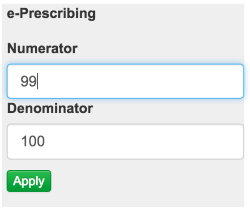
- Enter the Numerator and Denominator, derived from reports run off of your EHR, for each measure into MDinteractive (or claim exclusion if applicable).
- Upload supporting documentation.
There are 4 objectives:
- Objective: e-prescribing
- e-Prescribing (10 points)**
- Query of Prescription Drug Monitoring Program (PDMP) (10 points)**
- Objective: Provider to Patient Exchange
- Objective: Health Information Exchange
- Support Electronic Referral Loops by Sending Health Information (Option 1: 15 points)**
- Support Electronic Referral Loops by Receiving and Reconciling Health Information (Option 1: 15 points)**
- Health Information Exchange (HIE) Bi-Directional Exchange (Option 2: 30 points)
- Enabling Exchange under TEFCA (Option 3: 30 points)
- Objective: Public Health and Clinical Data Exchange (report 2 measures for 10 points)
- CMS will require reporting of the Immunization Registry Reporting and Electronic Case Reporting (unless an exclusion can be claimed).
- The Public Health Registry Reporting, Clinical Data Registry Reporting, and Syndromic Surveillance Reporting measures will be optional and MIPS eligible clinicians could earn 5 bonus points if they report a “yes” response for any one of them. Note reporting more than one of these optional measures won’t result in more than 5 bonus points.
- New in 2026: CMS has added an additional optional bonus measure, Public Health Reporting Using the Trusted Exchange Framework and Common Agreement™ (TEFCA™).
**There are exclusions available for most of the measures. If you meet and claim the exclusion for one or more of the required Promoting Interoperability performance category measures, the points for the measure will be redistributed to another measure or measures as follows:
- e-Prescribing exclusion - 10 points are redistributed equally among the Health Information Exchange objective - each becomes 25 points.
- Support Electronic Referral Loops by Sending Health Information exclusion - 20 points are redistributed to Provider to Patient Exchange objective making it worth 60 points (vs. 40).
- Support Electronic Referral Loops by Receiving and Incorporating Health Information exclusion - 20 points are redistributed to Support Electronic Referral Loops by Sending Health Information measure making it worth 40 points (vs. 20).
- Public Health and Clinical Data Exchange exclusion - if 2 different measures are excluded, the 10 points are redistributed to Provider to Patient Exchange objective making this measure worth 50 points.
Promoting Interoperability Required Attestations
- Perform or Review a Security Risk Analysis. The actions included in the Security and Risk Analysis measure are still required to be performed (attest yes) during the calendar year in which the performance period occurs, but it is an unscored measure. Beginning in 2026, clinicians must now also attest to having conducted security risk management activities, as required under the risk management component of the HIPAA Security Rule.
- Perform an Annual Assessment of the High Priority Guide (from the SAFER Guides):
- For the 2026 performance year, clinicians are required to conduct an annual self-assessment using the updated 2025 SAFER Guides for the High Priority Practices measure. The assessment can be completed at any time during the calendar year in which the performance period occurs. Clinicians may only attest “yes” for this measure; a “no” response will not meet the requirement.
- The High Priority Practices Guide of the Safety Assurance Factors for EHR Resilience (SAFER) Guides can be found here
- To complete the self-assessment, one must complete a review and mark the associated checkboxes (fully, partially, or not implemented) of recommended practices included in the beginning of the Guide.
- Detailed worksheets with the rationale for, and examples of how, to implement each recommended practices follows the checklist section of the Guide.
- These worksheets include likely sources of information that your practice may reference to complete your assessment of a recommended practice, as well as fillable note fields to record follow-up actions.
- Complete the Actions to Limit or Restrict Interoperability of CEHRT Attestation. This attestation statement aims to identify whether you or your health IT vendor acted in good faith and took necessary steps to prevent limiting or restricting the compatibility or interoperability of CEHRT.
- To complete this attestation, you will attest to the statement by entering a “yes” (certify that you acted in good faith when implementing and using your CEHRT to exchange electronic health information) or “no” (you don’t certify that you acted in good faith when implementing and using your CEHRT to exchange electronic health information) response.
- Complete the ONC Direct Review Attestation. This attestation statement confirms that you will cooperate with any ONC review of your certified health IT, including providing access and demonstrating how it is used if requested.
- To complete this attestation, you must attest “Yes” to the following statement: I (1) Acknowledge the requirement to cooperate in good faith with ONC direct review of his or her health information technology certified under the ONC Health IT Certification Program if a request to assist in ONC direct review is received; and (2) If requested, cooperated in
good faith with ONC direct review of his or her health information technology certified under the ONC Health IT Certification Program to the extent that such technology meets (or can be used to meet) the definition of CEHRT,
including by permitting timely access to such technology and demonstrating its capabilities as implemented and used by the MIPS eligible clinician in the field.
- To complete this attestation, you must attest “Yes” to the following statement: I (1) Acknowledge the requirement to cooperate in good faith with ONC direct review of his or her health information technology certified under the ONC Health IT Certification Program if a request to assist in ONC direct review is received; and (2) If requested, cooperated in
Note: Failure to attest “Yes” to the attestation statements will result in a score of zero for the MIPS Promoting Interoperability performance category.