A Shift Toward Reporting-Based Quality Measurement
Under LEAD, CMS is introducing a phased approach to eCQM reporting, recognizing both the importance of digital quality measurement and the operational challenges ACOs face in aggregating clinical data across disparate systems.
Key highlights include:
- eCQMs introduced alongside claims-based measures and CAHPS
- Initial emphasis on reporting rather than performance
- Gradual transition to required reporting over time
Specifically:
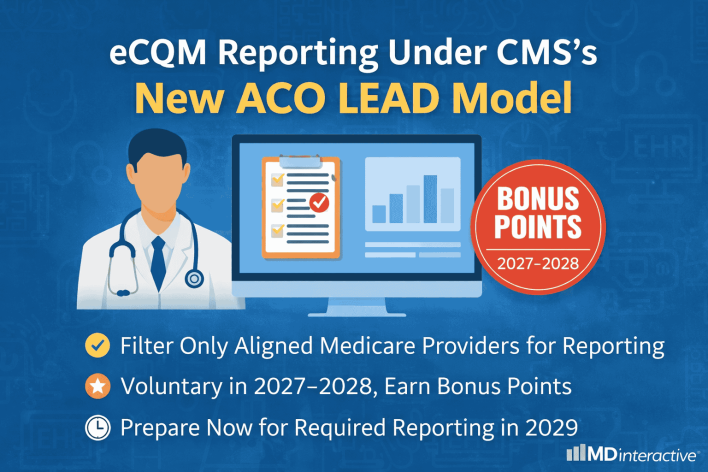
- Years 1–2 (2027–2028): eCQMs are voluntary
- Years 3–4: eCQMs become pay-for-reporting
- Year 5 and beyond: eCQMs are required
Importantly, even though eCQM reporting is voluntary in the first two years, ACOs can earn bonus points for submitting eCQMs in 2027 and 2028. Early participation is strongly encouraged, as it allows organizations to build workflows, validate data pipelines, and become operationally prepared before reporting becomes mandatory.
Medicare Alignment Matters for eCQM Reporting
A critical detail for ACOs is that eCQMs only need to be submitted for aligned Medicare beneficiaries/providers under the LEAD model.
However, this introduces a practical challenge:
- Many EHR systems struggle to filter eCQM populations down to only aligned Medicare patients
- Clinical data is often structured across all-payer populations, making segmentation difficult
This is where technology and vendor support become essential.
MDinteractive helps ACOs address this challenge by enabling filtering of all-payer eCQM data down to the required Medicare-aligned population, reducing the burden on provider organizations and minimizing reliance on EHR-specific limitations.
How eCQMs Fit into LEAD’s Quality Scoring Framework
The LEAD model uses a point-based quality scoring methodology, where ACOs earn points across required measures and convert performance into a percentage score.
- Each measure earns 0–10 points
- Scores are normalized based on total possible points
- Adjustments (including reporting-based components like eCQMs) are applied
- Final scores impact financial outcomes through a 3% quality withhold
Within this framework, eCQMs:
- Start as reporting-driven measures
- Provide incremental scoring opportunities (including early bonus points)
- Evolve into core performance measures over time
Will eCQM Reporting Use QPP?
A common question is whether eCQM reporting under LEAD will follow the same pathway as MSSP ACOs—specifically through the Quality Payment Program (QPP).
At this time, CMS has not explicitly confirmed that LEAD eCQM reporting will be submitted via QPP. However, given CMS’s broader push toward standardization and digital reporting, alignment with existing infrastructure remains a possibility.
Why Early eCQM Adoption Is a Strategic Advantage
Although eCQM reporting is optional at the start, waiting may create unnecessary risk.
Organizations that report early will benefit from:
1. Bonus Scoring Opportunities
Submitting eCQMs in 2027–2028 can earn additional points, directly improving quality scores.
2. Operational Readiness
Early adopters can:
- Identify data gaps
- Validate measure logic
- Refine submission workflows
3. Reduced Future Burden
By the time eCQMs become required, organizations that started early will already have stable, scalable processes in place.
Preparing for eCQM Success in LEAD
To succeed under LEAD, ACOs should begin preparing now:
- Evaluate EHR capabilities for population filtering and measure calculation
- Implement tools that support payer-specific segmentation
- Leverage vendor solutions like MDinteractive to simplify reporting workflows
- Start voluntary reporting early to capture bonus points and build experience
Final Thoughts
The LEAD model represents CMS’s continued evolution toward digital, data-driven quality measurement. eCQMs are not just another reporting requirement—they are a signal of where healthcare is headed.
For ACOs, the takeaway is clear:
- eCQMs will become essential
- Filtering Medicare-aligned populations is a key operational hurdle
- Early adoption provides both scoring and strategic advantages
Organizations that act now—rather than waiting for requirements to take effect—will be best positioned to succeed in the LEAD era.