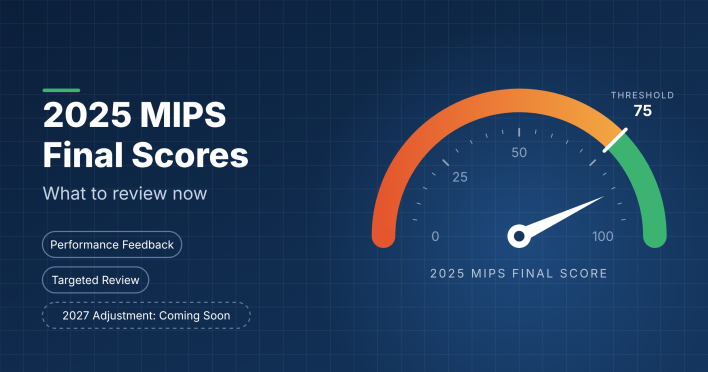
CMS has released final scores and performance feedback for the 2025 Merit-based Incentive Payment System (MIPS) performance year. These results are more than a summary of last year’s reporting: your 2025 final score will determine the MIPS payment adjustment applied to your Medicare Part B covered professional services in 2027. CMS expects to release the corresponding 2027 payment adjustment information sometime later this month. In the meantime, clinicians, practices, and APM Entities should review their final feedback now so there is time to investigate any unexpected results and request a targeted review if needed.
How to Access Your 2025 Performance Feedback
Sign in to the Quality Payment Program (QPP) website using the same HARP credentials used to submit your 2025 MIPS data.
From the home page:
- Select View Feedback.
- Choose the applicable organization, such as a Practice, APM Entity, or Virtual Group.
- Review the available final score and performance feedback reports.
Practice representatives may be able to view feedback at the individual, subgroup and group levels, depending on their access. Third-party representatives cannot access final performance feedback or payment adjustment information on behalf of a practice. Access to final performance feedback and payment adjustment information is generally limited to individuals with an authorized QPP role for the practice. Third-party intermediaries typically cannot view this information through their own QPP accounts.
If you do not have a HARP account or the appropriate QPP role, begin the access process as soon as possible.
Accessing Your Feedback in MDinteractive
Practices that report through MDinteractive can authorize MDinteractive to retrieve available QPP performance feedback reports. If you use MDinteractive for your MIPS reporting, log in to your MDinteractive account and locate "QPP Performance Feedback" under "Required Actions" on your MIPS dashboard.
- Status shows “Authorized”: Click Open to access your available QPP performance feedback reports.
- Status shows “Set Up”: Click Open and follow the prompts to authorize MDinteractive to access your QPP performance feedback. You will need a QPP HARP account to complete the authorization process.
What Should You Review?
Your performance feedback summarizes the data submitted to CMS and the information CMS collected on your behalf. Review the full report, not just your final score, including:
- Performance category scores and weights
- Bonus points and improvement scoring
- Measure-level performance data and scores
- Activity-level scores
- Supplemental reports for administrative claims-based quality and cost measures
- Comparative quality and cost feedback if you reported an MVP
Compare the results with your submission records and any applicable eligibility, Qualifying APM Participant (QP), special status or exception determinations. If a score, category weight or other result does not appear consistent with your records, review it promptly to determine whether a targeted review may be appropriate.
What Does Your 2025 Final Score Mean?
The 2025 MIPS performance threshold was 75 points:
- A score below 75 points results in a negative 2027 MIPS payment adjustment.
- A score of exactly 75 points results in a neutral adjustment.
- A score above 75 points results in a positive adjustment.
The maximum negative adjustment is –9%. Positive adjustments are subject to budget neutrality and will not be known until CMS releases the 2027 payment adjustment information. CMS expects this information to be available approximately one month after final scores are released.
Special Access Considerations for Shared Savings Program ACOs
Medicare Shared Savings Program ACOs should identify at least one person who can access the ACO’s feedback. ACO representatives use their ACO Management System (ACO-MS) credentials, with a Security Official or approved Staff User role, to access QPP performance feedback.
Representatives of an ACO Participant TIN or a practice whose clinicians receive the APM Entity’s final score will not automatically be able to view the APM Entity’s feedback. They must be approved as a staff user for the APM Entity. Individual clinicians with the QPP Clinician role can also view the final score they receive through the ACO.
Note for ACO Participant TINs: Practices that access performance feedback at the practice level rather than through the APM Entity may see a Quality score of zero. This may occur because the ACO, not the individual practice or clinician, reported the APP Plus quality measures. ACO-level results are available only to users with the appropriate APM Entity access. Practices that reported Promoting Interoperability data as a group or individual will also see a Promoting Interoperability score and automatic full credit for Improvement Activities.
Clinicians receive the highest final score attributable to their TIN/NPI combination, and only clinicians on the ACO’s APM Participant List receive the ACO’s score. A low practice-level score does not necessarily determine the payment adjustment.
When a Targeted Review May Be Appropriate
A targeted review allows CMS to reconsider the calculation of a MIPS final score when an individual clinician, group, subgroup, Virtual Group or APM Entity believes an error occurred.
Examples include:
- Data were submitted under the wrong TIN or NPI.
- A clinician had QP status and should not receive a MIPS payment adjustment.
- A performance category was not automatically reweighted even though the clinician or group qualified for reweighting.
- Submitted data, eligibility information or an applicable exception does not appear to have been reflected correctly.
These examples are not exhaustive. The key question is whether the final score appears inconsistent with the information CMS should have used.
How to Request a Targeted Review
The targeted review period opened when final scores were released. It will remain open for approximately 60 days and will close 30 days after CMS releases the 2027 MIPS payment adjustments.
To submit a request:
- Sign in to the QPP website with your HARP credentials. Shared Savings Program ACO representatives should use their ACO-MS credentials.
- Select Targeted Review from the left-hand navigation.
- Explain why you believe the final score is incorrect and submit the request at the same reporting level used for the original submission.
- Be prepared to provide supporting documentation. The documentation CMS requests will depend on the circumstances.
If CMS approves the request and the decision changes the score, CMS will update the final score and any associated payment adjustment as soon as technically feasible. Targeted review decisions are final and cannot be appealed further.
Do not wait for the deadline if something appears incorrect. Starting early gives you time to gather submission confirmations, screenshots, eligibility records, exception approvals and other supporting materials.
CMS’s 2025 Targeted Review User Guide provides instructions and examples of circumstances that may or may not warrant a request. You may also contact the QPP Service Center at 1-866-288-8292 (TRS: 711) or QPP@cms.hhs.gov.
What to Do Next
Take these steps now:
- Confirm that someone in your organization can access the 2025 feedback.
- Download and retain the final feedback and supplemental reports.
- Compare the results with your 2025 submission records and eligibility information.
- Document any discrepancy and request a targeted review as soon as possible if you believe CMS made an error.
- Return to the QPP website when CMS releases the 2027 payment adjustment information and confirm that it aligns with the final score.
MDinteractive can help customers access their feedback, understand their results and determine whether an issue may warrant further review. Contact us at support@mdinteractive.com or 800-634-4731 if you have questions about your 2025 MIPS performance feedback.