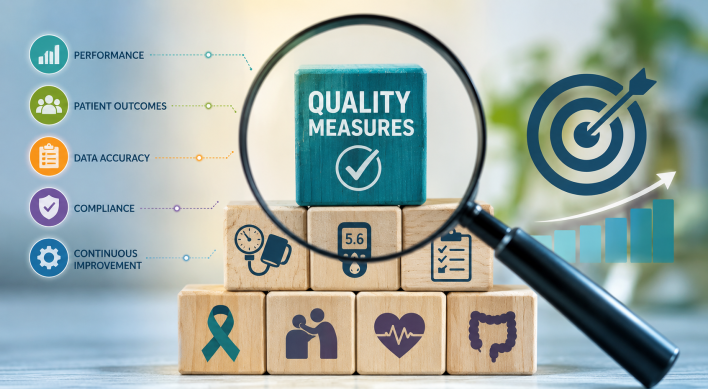
With the 2026 performance year well underway, MSSP ACOs should be using ongoing quality measure submissions and performance review to evaluate how reporting workflows, data completeness, and measure performance are trending across participating organizations. More than a reporting exercise, ongoing performance monitoring helps organizations identify workflow gaps, validate data capture, and stay on track throughout the performance year. As organizations review mid-year performance, each APP measure presents its own operational, documentation, and reporting considerations heading into the second half of 2026.
What Mid-Year Reporting Can Reveal
For ACOs reviewing submitted quality measure files throughout the performance year, the value of mid-year review is not just knowing where performance stands, but understanding what may be driving performance trends.
A lower than expected rate may reflect true clinical opportunity, but it may also point to data that has not yet been captured or submitted, incomplete EHR mapping, gaps in external data capture, inconsistent documentation workflows, or denominator issues. Without regular review, these problems can remain hidden until later in the year, when they are more difficult to correct.
This is especially important in multi-practice TINs and multi-EHR environments, where reporting performance can vary significantly across participating practices.
2026 APP Actively Submitted Quality Measures
The following are the actively submitted APP quality measures required for the 2026 performance year. They do not include administrative claims measures or CAHPS for MIPS Survey measure, which follow separate reporting processes:
- #1 Diabetes: Glycemic Status Assessment Greater Than 9%
- #112 Breast Cancer Screening
- #113 Colorectal Cancer Screening (new in 2026)
- #134 Screening for Depression and Follow Up Plan
- #236 Controlling High Blood Pressure
Below are several key considerations for each measure as organizations continue reviewing performance throughout the 2026 performance year.
#1 Diabetes: Glycemic Status Assessment Greater Than 9%
For the diabetes measure, ACOs should be reviewing whether A1C data is flowing consistently from EHRs, laboratories, HIEs, and other external data sources Mid-year performance data can help identify whether lab results are being captured in structured fields and whether external lab data is being mapped correctly.
When performance appears lower than expected, organizations should look closely at data completeness before assuming the issue is purely clinical. Missing A1C values, inconsistent lab result formatting, or gaps in external lab integration can all affect reported performance. Because the measure is driven by the patient’s most recent documented A1C result, organizations should confirm that both the lab value and the associated test date are being captured accurately within reporting workflows.
Denominator accuracy is also important. ACOs should confirm that eligible patients are being included correctly and that attribution, eligibility, and exclusion logic are not unintentionally affecting reported performance.
#112 Breast Cancer Screening
Breast Cancer Screening continues to require close attention to external data capture. Many mammograms occur outside the primary care setting, which means performance depends heavily on how well imaging results and supplemental data are collected and reconciled.
For 2026, the age criteria are aligned across the eCQM, MIPS CQM, and Medicare CQM versions of the measure, capturing women ages 40 to 74 who received a mammogram within the 27 months prior to the end of the measurement period. Additionally, the MIPS CQM and Medicare CQM specifications added a definition of "reviewed." To meet the quality action, there must be documentation in the medical record that the clinician reviewed the mammography report. The mammography report may also be provided by the patient for the clinician's review during the visit and should be documented in the medical record.
Ongoing reporting review is especially useful for identifying whether screening data from external imaging centers, HIE connections, FHIR-based data exchange, and supplemental sources is appearing as expected. Organizations should also confirm that workflows support documentation of clinician review when mammography results are received from external sources or presented by patients during office visits. It also gives organizations time to assess whether patient outreach efforts are needed for individuals who remain overdue.
#113 Colorectal Cancer Screening
Colorectal Cancer Screening is new to the required APP measure set for 2026, making it one of the most important areas for ACOs to monitor throughout the performance year.
This measure can involve multiple types of documentation, including colonoscopy history, FIT/FOBT results, and other accepted screening methods. For the MIPS CQM and Medicare CQM specifications, a definition of "reviewed" has been added to the measure. To meet the quality action, there must be documentation in the medical record that the clinician reviewed the colorectal screening report. The colorectal screening report may also be provided by the patient for the clinician's review during the visit and should be documented in the medical record.
Because much of this information may come from outside the primary EHR, ACOs should be reviewing whether external screening data is being captured consistently across participating practices and whether workflows support documentation of clinician review when colorectal screening reports are received from outside sources or presented by patients during visits.
Mid-year reporting trends can help reveal whether the issue is performance, data capture, or workflow variation. For example, an organization may have completed screenings that are not appearing in the measure because results are stored in unstructured notes, received from outside facilities, or not integrated into the reporting workflow.
This measure is also highly actionable during the second half of the year. FIT/FOBT testing can often be completed relatively quickly once patients are engaged, which makes timely outreach and accurate patient lists especially important.
#134 Screening for Depression and Follow Up Plan
For the depression screening measure, ACOs should use current performance data to evaluate whether both required components are being documented consistently: the screening itself and the follow up plan when indicated.
Performance issues on this measure often reflect workflow variation across practices. Some clinicians may be completing screenings but not documenting them in the structured fields required for reporting. Others may document the screening but miss the follow up plan component when a positive screen occurs.
Because this measure depends heavily on clinical workflow adoption, performance review should be paired with practice level feedback. If performance varies significantly by location or provider group, the issue may be related to EHR templates, staff workflows, physician engagement, or inconsistent use of prompts.
Addressing these patterns earlier in the year gives organizations more time to reinforce documentation expectations and standardize workflows across participating practices.
#236 Controlling High Blood Pressure
Controlling High Blood Pressure is another measure where ongoing reporting review can reveal both clinical and data quality issues.
ACOs should review whether qualifying blood pressure readings are being documented in structured fields and whether both systolic and diastolic values are being captured consistently. Incomplete vital sign documentation, inconsistent workflows across practices, or delays in data availability can all affect reported performance. Organizations should also confirm that the most recent blood pressure reading and the associated reading date are being captured correctly, since the measure is based on the latest documented reading during the performance period.
Denominator accuracy also matters. Organizations should confirm that the eligible hypertensive population is being identified correctly and that exclusions are being applied appropriately.
Because blood pressure control can be influenced by ongoing clinical management, mid-year performance monitoring gives ACOs an opportunity to identify patients who may benefit from follow up, care management, or additional outreach before the end of the performance year.
In addition to reviewing measure performance, organizations should also be evaluating the underlying reporting workflows and technical processes supporting data submission throughout the performance year.
QRDA and FHIR Readiness Should Be Reviewed Throughout the Year
Ongoing quality measure submissions also give ACOs an opportunity to validate the technical side of reporting. For organizations submitting through QRDA workflows, validation should not wait until the final submission period.
Regular review of QRDA files and validation results can help identify formatting issues, mapping problems, vendor configuration concerns, or missing data elements earlier in the year. This is especially important for ACOs working across multiple EHRs, recent system upgrades, new vendor relationships, or complex supplemental data workflows.
FHIR-based data exchange and external data integrations should also be evaluated throughout the year, particularly for organizations relying on interoperability connections or external data sources to support measure performance. When data capture or integration issues are identified early, there is more time to work with vendors, practices, and data partners to improve completeness before final reporting deadlines.
Benchmark Methodology Remains Important
As ACOs review ongoing performance trends, they should also understand how benchmark methodology may affect scoring expectations. For PY 2026 Medicare CQMs, CMS transitioned three measures from flat benchmarks to historical benchmarks:
- #001SSP Diabetes: Glycemic Status Assessment Greater Than 9%
- #134SSP Screening for Depression and Follow Up Plan
- #236SSP Controlling High Blood Pressure
The following Medicare CQMs continue using flat benchmarks:
- #112SSP Breast Cancer Screening
- #113SSP Colorectal Cancer Screening
Understanding these benchmark differences can help ACOs prioritize where operational improvement, workflow support, or outreach may have the greatest impact.Organizations reviewing 2026 benchmark scoring can access the current CMS benchmark resources here: 2026 QPP Benchmarks
Staying on Track Through Ongoing Review
The strongest APP reporting strategies are not built around year-end remediation. They rely on continuous review of quality measure submissions, regular validation of reporting files, and ongoing communication with participating practices.
At mid-year, ACOs should be asking whether the data tells a complete and accurate story. Are measures trending as expected? Are supplemental data sources being captured? Are workflows consistent across practices? Are denominator populations accurate? Are QRDA and FHIR processes working as intended?
Organizations that use ongoing reporting review to answer these questions throughout the year are better positioned to improve performance, reduce reporting risk, and approach final submission with greater confidence.