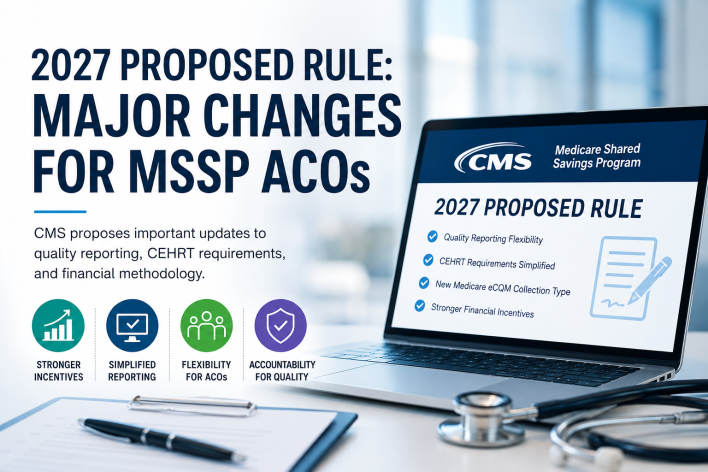
On July 14, 2026, the Centers for Medicare & Medicaid Services (CMS) released the 2027 Medicare Physician Fee Schedule (PFS) proposed rule, which includes some of the most significant proposed changes to the Medicare Shared Savings Program (MSSP) in recent years. While the rule touches on benchmarking, beneficiary assignment, and engagement, the quality reporting and CEHRT provisions deserve particular attention. The public comment period closes September 14, 2026.
CMS will consider stakeholder feedback submitted during the public comment period before issuing the final rule later this year.
A Major Shift in Quality Reporting and CEHRT Requirements
The 2027 proposed rule includes several interconnected changes to how ACOs report quality, spanning collection types, benchmarks, reporting flexibility, and measure sets. Taken together, these proposals are intended to reduce reporting burden while supporting ACOs' transition to digital quality measurement without sacrificing accountability for quality.
MIPS CQM Reporting Extended
Perhaps the most immediately relevant change for ACOs is CMS's proposal to extend the MIPS CQM collection type for performance year 2027 and subsequent performance years. MDinteractive has long advocated for this kind of flexibility, and we view this as a positive development for ACOs. It gives organizations more time to transition to digital quality measurement without disrupting current reporting workflows - a direct response to concerns raised by ACOs about the pace of that transition.
The proposal would also extend the associated reporting incentive beyond performance year 2026. For ACOs reporting MIPS CQMs, this preserves the current incentive that supports meeting the MSSP quality performance standard through the existing "10/40" quality performance pathway (achieving at least the 10th percentile on one outcome measure and the 40th percentile on one other quality measure), helping ACOs qualify for the maximum available shared savings and, for ENHANCED track ACOs, avoid maximum shared losses.
Subject to future rulemaking, CMS anticipates a transition to FHIR-based reporting beginning with performance year 2028. FHIR-based reporting would be voluntary for performance years 2028 and 2029 before becoming mandatory for applicable APP Plus measures beginning in performance year 2030. CMS also anticipates sunsetting the reporting incentive beginning with performance year 2028, when the FHIR transition period begins, and sunsetting the MIPS CQM collection type beginning in performance year 2030, when FHIR-based reporting becomes mandatory.
CEHRT Requirements: A Simpler Path Forward
CMS is also proposing to simplify CEHRT requirements in two important ways. First, for performance years 2025 and 2026, CMS has extended enforcement discretion, meaning ACOs that do not meet existing MIPS Promoting Interoperability (PI) reporting requirements will not face compliance actions, with no impact on shared savings eligibility.
Beginning in performance year 2027, the existing PI reporting requirement would sunset entirely and be replaced with a requirement that ACOs satisfy one of three options:
- Option 1 — Report via eCQMs or Medicare eCQMs: Completely report at least one APP Plus measure through the eCQM or Medicare eCQM collection type and meet data completeness requirements. No additional attestation required.
- Option 2 — Attest to FHIR use: Completely report at least one APP Plus measure through any available collection type, meet data completeness requirements, and attest that a FHIR-based certified Health IT Module was used to support data collection for that measure. (In practice, this option is most relevant for ACOs reporting MIPS CQMs or Medicare CQMs, since eCQM and Medicare eCQM reporters are automatically satisfied under Option 1.)
- Option 3 — Attest to a CEHRT use metric: Attest that at least one provider in each participant TIN performed one of the following using CEHRT:
- Electronically prescribed at least one prescription
- Participated in bi-directional health information exchange with an HIE
- Provided at least one patient electronic access to their health information
ACOs must also publicly report which option they selected, replacing the current requirement to report MIPS Promoting Interoperability scores.
TIN Exclusions from Quality Submissions
Beginning in performance year 2026, ACOs may exclude one or more participant TINs from quality data submissions, provided the remaining TINs represent at least 95 percent of the ACO's assigned beneficiaries prior to the application of measure specifications. This proposal is a positive step toward reducing reporting burden while recognizing the operational challenges many ACOs face with participant practices and EHR capabilities. The 95 percent threshold is evaluated separately for each measure, meaning an ACO may exclude different TINs for different measures depending on circumstances.
Allowable exclusions include unforeseen circumstances outside the ACO's control, such as a practice closure, a specialty EHR that does not support APP Plus measures, or other circumstances determined by CMS. Exclusions based on beneficiary demographics or health status, or the estimated impact of a TIN on the ACO's quality score, are not permitted.
The 75 percent MIPS data completeness requirement remains unchanged. After any allowable TIN exclusions are applied, data completeness is calculated based on the quality data submitted by the ACO.
Beginning in performance year 2026, CMS will provide quarterly aggregate reports through the ACO Management System Data Hub (a Quarter 3 preview and Quarter 4 definitive report) to help ACOs verify they meet the 95 percent threshold before submitting quality data. CMS also retains the right to audit TIN exclusions and may request supporting documentation.
APP Plus Measure Set Updates
The proposed rule would remove two measures that had been scheduled for inclusion in the APP Plus set - Initiation and Engagement of Substance Use Disorder Treatment (Quality ID: 305) and Adult Immunization Status (Quality ID: 493). This would keep the measure set at eight measures for performance year 2027: five clinician-reported measures, two administrative claims-based measures, and the CAHPS for MIPS Survey.
The table below lists the quality measures included in the APP Plus Quality Measure Set for Shared Savings Program ACOs beginning in performance year 2027.
| Quality Measure ID | Measure Title | Collection Type |
| 001/CMS122 | Diabetes: Glycemic Status Assessment Greater Than 9% | eCQMs/MIPS CQMs/Medicare CQMs/Medicare eCQMs |
| 112/CMS125 | Breast Cancer Screening | eCQMs/MIPS CQMs/Medicare CQMs/Medicare eCQMs |
| 113/CMS130 | Colorectal Cancer Screening | eCQMs/MIPS CQMs/Medicare CQMs/Medicare eCQMs |
| 134/CMS2 | Preventive Care and Screening: Screening for Depression and Follow-up Plan | eCQMs/MIPS CQMs/Medicare CQMs/Medicare eCQMs |
| 236/CMS165 | Controlling High Blood Pressure | eCQMs/MIPS CQMs/Medicare CQMs/Medicare eCQMs |
| 321 | CAHPS for MIPS | CAHPS for MIPS Survey |
| 479 | Hospital-Wide, 30-day, All-Cause Unplanned Readmission (HWR) Rate for MIPS Eligible Clinician Groups | Administrative Claims |
| 484 | Clinician and Clinician Group Risk-standardized Hospital Admission Rates for Patients with Multiple Chronic Conditions | Administrative Claims |
The proposed rule also includes updates to the specifications for the following quality measures:
- Quality ID 001 – Diabetes: Glycemic Status Assessment Greater Than 9%
- eCQM: Updated logic prioritizes numerical glycemic status results over null values, improving the capture of clinically meaningful results.
- Quality ID 134 – Preventive Care and Screening: Screening for Depression and Follow-Up Plan
- eCQM: Expands numerator eligibility to include active depression medication or depression management interventions and clarifies screening tool guidance for certain adolescent patients.
- MIPS CQM and Medicare CQM: Adds a denominator exception for patients previously screened by another clinician during the performance period, supporting team-based care.
- Quality ID 479 – Hospital-Wide 30-Day All-Cause Unplanned Readmission
- Administrative Claims: Removes the denominator exclusion for beneficiaries with a COVID-19 diagnosis present on admission.
New Medicare eCQM Collection Type
The proposed rule would establish a new Medicare eCQM collection type beginning in performance year 2027. Unlike existing eCQMs, Medicare eCQMs would be reported only on the ACO's assigned beneficiaries rather than all patients regardless of payer, directly addressing longstanding data aggregation challenges. Medicare eCQMs would be scored using flat benchmarks and are anticipated to sunset in performance year 2030 when mandatory FHIR-based reporting begins. ACOs should note that Medicare eCQMs are excluded from the eCQM/MIPS CQM reporting incentive and the Complex Organization Adjustment.
Flat Benchmarks
The proposal would extend flat benchmarks to all Medicare CQM measures for performance year 2027 and subsequent performance years. It would also apply flat benchmarks retroactively to three additional measures for performance year 2026, meaning all five APP Plus Medicare CQMs would use flat benchmarks beginning in 2026. Subject to future rulemaking, CMS anticipates sunsetting flat benchmarks for Medicare CQMs beginning in performance year 2030 when FHIR-based reporting becomes mandatory.
Scoring Protections
The proposed rule would also modify two existing scoring protections for performance year 2027 and beyond. The protection triggered when a measure is excluded from MIPS scoring would be narrowed—under current policy it applies when even one measure is excluded; under the proposal it would apply only when four or more measures are excluded, at which point the ACO receives the higher of its actual quality score or the 40th percentile score. The protection for measures that lack a benchmark would be eliminated entirely, as flat benchmarks for Medicare CQMs and Medicare eCQMs make this scenario effectively obsolete.
Financial Methodology: Stronger Incentives Across the Board
The proposed rule also includes several changes aimed at making MSSP participation more financially attractive and reducing the discouraging effect of benchmark rebasing. Key proposals include:
- Increase the BASIC track Level E shared savings rate from 50% to 60%
- Reduce the maximum weight for positive regional adjustments in the ENHANCED track from 50% to 35% (for lower-spending ACOs)
- Increase the prior savings adjustment scaling factor
- Risk-adjust the 5% cap on upward benchmark adjustments to allow higher adjustments for ACOs with higher-risk, higher-cost populations
- Establish a new growth adjustment to incentivize new ACO participation
On the Accountable Care Prospective Trend (ACPT), CMS proposes guardrails to address projection error in benchmark update calculations. The lower guardrail would be applied retroactively to existing agreement periods beginning with performance year 2025 reconciliation.
Final Thoughts
Overall, the proposed rule represents a significant effort to ease the transition to digital quality measurement while simplifying quality reporting requirements and strengthening MSSP financial incentives. If finalized, these changes would provide ACOs with greater flexibility during the transition to FHIR-based reporting while preserving CMS's focus on accountability for quality.
CMS is accepting public comments through September 14, 2026, and is expected to publish the final rule later this year. ACOs should review these proposals carefully and consider submitting comments to CMS before the September 14, 2026, deadline.