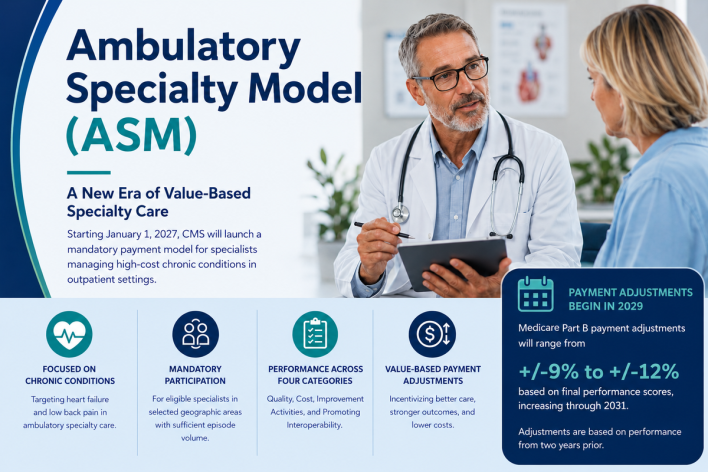
Beginning January 1, 2027, the Centers for Medicare & Medicaid Services (CMS) will launch the Ambulatory Specialty Model (ASM), a mandatory payment model designed to expand value-based care into outpatient specialty practice. Unlike previous CMS Innovation Center models that largely focused on hospitals or primary care, ASM is aimed specifically at specialists managing high-cost chronic conditions in ambulatory settings.
The model will run from January 1, 2027, through December 31, 2031. Each year, CMS will evaluate participants' performance and use those results to adjust Medicare Part B payments two years later.
What Is Ambulatory Specialty Care?
Ambulatory specialty care refers to specialized medical services provided in outpatient settings rather than during hospital admissions. Many chronic conditions are primarily managed in these settings, making specialists an important part of improving long-term patient outcomes and controlling healthcare costs.
ASM focuses on how specialists manage chronic disease over time rather than on isolated procedures or hospital episodes. While the model's cost performance category is based on episode-based cost measures (EBCMs)—the same measures used to determine clinician eligibility—it evaluates overall performance across multiple domains intended to encourage coordinated, high-quality care.
Why CMS Created ASM
CMS developed ASM to test whether value-based payment incentives can improve quality while reducing Medicare spending for chronic conditions that account for a significant share of healthcare utilization.
The model encourages specialists to:
- Identify and manage patients earlier in the course of chronic disease.
- Follow evidence-based clinical guidelines.
- Improve care coordination with other providers.
- Enhance the patient experience.
- Deliver high-quality care while managing costs responsibly.
Which Conditions and Specialists Are Included?
At launch, ASM focuses on two chronic conditions associated with substantial Medicare spending:
- Heart failure – Cardiology
- Low back pain – Anesthesiology, Pain Management, Interventional Pain Management, Neurosurgery, Orthopedic Surgery, and Physical Medicine & Rehabilitation
CMS may expand the model to additional specialties and conditions in future years.
Who Must Participate?
Unlike many CMS Innovation Center payment models, ASM participation is mandatory for eligible physicians who meet CMS's participation criteria.
Clinicians are selected based on both geographic location and episode volume. CMS will require participation for eligible physicians practicing in selected Core-Based Statistical Areas (CBSAs) and Metropolitan Divisions.
To qualify, a physician must have attributed 20 or more episode-based cost measure (EBCM) episodes for the relevant condition. CMS will verify the eligibility of all ASM participants using calendar year 2025 data. The final list of 2027 ASM participants will be released in late summer 2026. CMS released a preliminary participant list in February 2026 and will publish the final list in summer 2026. The final list may differ as CMS re-runs eligibility determinations on updated claims data.
At this time, the model applies only to eligible physician specialties. Nurse practitioners, physician assistants, and other nonphysician practitioners are not included.
CMS has stated that mandatory participation improves the reliability of model results by reducing selection bias and allowing findings to be applied more broadly across Medicare.
How Performance Is Measured
Participants are assessed across four performance categories:
- Quality
- Cost
- Improvement Activities
- Promoting Interoperability
CMS uses participants' final scores across the four performance categories to determine whether Medicare Part B payments will receive a positive, negative, or neutral adjustment. Payment risk levels increase over time: 9% upside or downside for 2027–2028 performance years, rising to 10%, 11%, and 12% in subsequent years.
Participants may also earn bonus points: up to 10 points for complex patient populations, 10 points for small practices (2–15 clinicians), or 15 points for solo practitioners.
Beginning with the 2029 payment year, CMS will apply Medicare Part B payment adjustments based on participants' 2027 performance. Participants must report required data within three months after each performance year ends (e.g., March 31, 2028 for the 2027 performance year).
How ASM Differs From MIPS
Although ASM uses performance categories that resemble the MIPS Value Pathways (MVP) framework, it is not part of the Merit-based Incentive Payment System (MIPS).
Instead, ASM is a CMS Innovation Center payment model with its own performance assessment and payment adjustment methodology. During applicable ASM performance years, participating clinicians will be evaluated under ASM rather than the traditional MIPS program. ASM participants are not required to complete MIPS reporting for any ASM performance year in which they meet ASM participant eligibility criteria.
Can Participants Continue in Other CMS Programs?
Yes. Participation in ASM does not prevent clinicians from participating in other CMS Innovation Center models or accountable care organizations, including the Medicare Shared Savings Program (MSSP), provided they otherwise meet the requirements of those programs.
CY 2027 Proposed Rule: Updates to Watch
On July 14, 2026, CMS released the CY 2027 Physician Fee Schedule proposed rule, which includes several ASM-specific proposals. These are not yet final—CMS will issue the final rule around November 1, 2026, after a public comment period that closes September 14.
Key proposals include:
- Adding a claims-based measure of potentially unnecessary lumbar MRI use and replacing a retiring functional-status measure with MIPS Measure Q182 (Functional Outcome Assessment) for the low back pain cohort;
- A voluntary patient-reported outcome submission option with a scoring incentive;
- A rural adjustment for participants in rural areas; and
- Clarification that quality will be scored in deciles relative to peers within each disease cohort rather than against a national benchmark.
Preparing for 2027
Although ASM does not begin until 2027, specialists who may be affected should begin preparing now. Understanding historical Medicare episode volume, strengthening clinical workflows, and ensuring the necessary data infrastructure is in place can help practices adapt more smoothly if selected for participation.
Practical preparation steps include:
- Review historical Medicare episode volume to assess potential eligibility.
- Evaluate care coordination and referral workflows.
- Strengthen clinical documentation practices.
- Review quality reporting processes.
- Confirm that electronic health record systems support interoperability and data sharing.
- Monitor future CMS guidance for additional implementation details and updates.
Bottom Line
The Ambulatory Specialty Model represents a significant expansion of value-based payment into specialty care. Specialists who understand the model early and invest in care coordination, preventive approaches, and performance improvement will be better positioned for success when ASM takes effect in 2027.